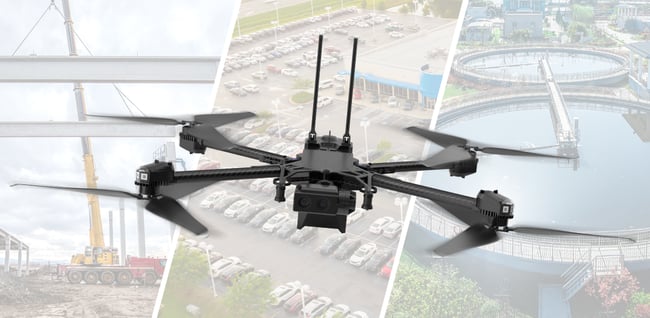
Drone security is a managed commercial security service that uses automated or remotely operated drones to patrol properties, investigate alerts, and give trained security teams live visibility across large outdoor areas. It helps businesses see what fixed cameras and ground patrols may miss, verify activity faster, and coordinate the right response.
This guide focuses on drones used to protect commercial properties. It does not cover counter-drone systems, drone jammers, or technology designed to detect or disable unauthorized aircraft.
For businesses with large perimeters, including corporate campuses, high-value outdoor assets, remote areas, or recurring blind spots, drone security connects detection, aerial investigation, human verification, and response in one coordinated process. The result is protection from above and confidence on the ground.
What Is Drone Security?
Drone security combines professional drone operations with monitoring, site-specific patrol planning, and approved response protocols. Instead of treating the drone as a standalone device, a managed program connects the aircraft to trained pilots, security operators, cameras, detection tools, and ground resources that can act when an incident is verified.
A professional drone security system may include:
- Automated or remotely operated drones
- Docking and charging stations
- High-resolution, thermal, and night-vision cameras
- Scheduled patrols and alert-triggered deployment
- FAA-certified remote pilots
- Live monitoring and incident verification
- Integration, response protocols, and incident reporting
This is different from buying a recreational drone and assigning an employee to fly it. An internal program also requires trained personnel, maintenance, insurance, software, compliance management, monitoring, and accountability.
Titan's Drone as a Service (DaaS) model brings those elements together. The drone can launch, patrol, land, and recharge automatically, while Titan's remote pilots and monitoring personnel maintain human oversight.
How Does Drone Security Work?
Drone security turns a scheduled patrol or detected event into a fast, structured response. The drone moves to the area of concern, streams live visual intelligence to trained personnel, and helps the security team determine what is happening before selecting the appropriate ground response and documenting the outcome.
A typical mission follows six stages:
- Detect. A scheduled patrol begins or a camera, sensor, analytics event, or operator identifies activity that needs attention.
- Deploy. The drone launches from its dock and follows a planned route or travels to a designated location.
- Investigate. High-definition and thermal cameras provide an aerial view, including areas beyond fixed-camera coverage.
- Verify. Trained personnel assess whether the activity is routine, suspicious, or a confirmed security event.
- Respond. The team follows the client's protocol, engaging a virtual guard, patrol, officer, property contact, or law enforcement when appropriate.
- Document. Video, operator actions, and the outcome are recorded.

Automation supports speed, but it does not remove human judgment. Titan's automated security drone model keeps trained pilots and monitoring professionals connected to every operation.
What Security Problems Can Drone Patrols Help Solve?
Drone security adds mobility and rapid aerial verification, while cameras, officers, and mobile patrols provide different strengths. The right choice depends on the property, hours of coverage, threat profile, response requirements, and the role each layer must perform within the complete security program.
|
Security layer |
Core strength |
Primary limitation |
Best application |
|
Drone security |
Mobile aerial visibility and rapid incident verification |
Primarily suited to outdoor coverage and subject to flight conditions |
Large properties, perimeters, blind spots, and alert response |
|
Fixed cameras |
Persistent visibility within a defined field of view |
Limited by placement, obstacles, and line of sight |
Entrances, gates, buildings, and known risk areas |
|
On-site officers |
Visible human presence, access control, and direct intervention |
One person can cover only a limited area at a time |
Active facilities, controlled entry, and response |
|
Mobile patrols |
Flexible physical checks and dispatched ground response |
Coverage is periodic between visits |
Scheduled inspections and verified incident response |
Drones are not a universal replacement for guards or cameras. Their strongest role is often to make the existing program more effective by inspecting an alert while an officer remains at a critical post or giving a patrol better information before arrival.
Titan coordinates drone security, virtual monitoring, patrols, and choice on-site officers through one integrated approach. Each layer has a defined role based on the property’s risks.
What Is the ROI of Drone Security?
The ROI of drone security comes from improving how resources are allocated, how quickly incidents are verified, and how much property can be covered. Value may come from labor efficiency, avoided losses, better documentation, and faster response. Actual savings depend on site size, operating hours, equipment, patrol frequency, and the response plan.
Businesses should evaluate value across several areas:
- Coverage achieved per patrol
- Time required to investigate an alert
- Reduction in unnecessary physical dispatches
- More strategic use of ground personnel
- Loss exposure, documentation, and scalability
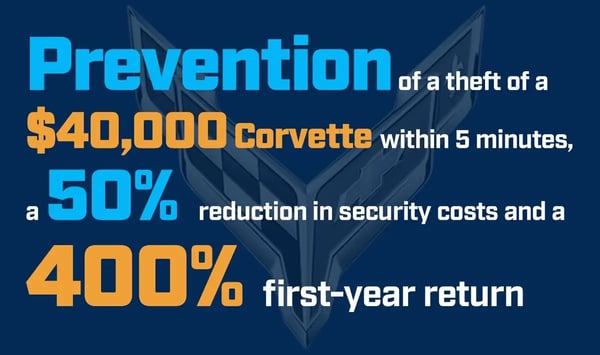
A recent Titan drone security deployment for a pair of Auto Dealerships shows how these factors work together. Molle Toyota and Cable Dahmer Chevrolet shared a drone security program across their properties. Titan's published case study reports that the system helped deter an attempted theft of a $40,000 Corvette within five minutes, with minimal vehicle damage, a 50 percent reduction in security costs, and a 400 percent first-year return.
Those results reflect one operating environment, not a universal forecast. Titan's Drone Security ROI Calculator can help compare current spending with a potential deployment before a site assessment tests the assumptions against actual risks and response needs.
How Does Titan Manage FAA Compliance and Drone Operations?
Professional drone security depends on certified pilots, operating authority, flight planning, safety procedures, and ongoing oversight. Titan manages those requirements through FAA-certified remote pilots, geofenced boundaries, monitoring-center coordination, maintenance, and applicable waiver management. Each property is reviewed before deployment.
In 2024, Titan received a nationwide Beyond Visual Line of Sight (BVLOS) waiver. BVLOS authority allows approved operations without requiring the pilot to maintain direct visual contact with the aircraft throughout the mission. That capability is especially important for large properties, remote infrastructure, and multi-site programs where line-of-sight limitations would otherwise restrict coverage.
In 2026, Titan also achieved FAA approval for one-to-many drone operations. The amended waiver allows one remote pilot to oversee up to four automated drones simultaneously across multiple states while maintaining centralized human oversight.
These capabilities make deployment more scalable, but they do not remove the need for property-specific review. Airspace, weather, privacy considerations, and site conditions still shape every program.
Which Industries Use Drone Security?
Drone security is best suited to commercial environments where valuable assets are spread across large, outdoor, remote, or changing spaces. The strongest applications combine a clear visibility problem, meaningful distance between assets and responders, and a defined process for verification and ground response.
Automotive Dealerships
Dealerships protect high-value vehicles across sales lots, overflow areas, service departments, and spaces between buildings. Drone patrols can investigate after-hours activity and direct officers to the correct location. Titan's automotive security solutions combine aerial coverage with monitoring and response.
Construction and Solar Construction Sites
Construction sites change every day as equipment, materials, access roads, and structures move. Drone patrol routes can adapt as the site evolves. The same flexibility supports solar construction security, where panels, staging zones, and wide perimeters create changing coverage needs.
Farms and Agricultural Properties
Farms may include distant boundaries, barns, equipment yards, fuel tanks, and access roads. Fixed cameras protect priority locations, while drone response reduces distance as a barrier to verification and helps eliminate farm security blind spots.
Logistics, Warehousing, and Distribution
Distribution centers and logistics yards have wide perimeters, trailers, loading areas, outdoor inventory, and multiple access points. Drones can investigate alarms and give ground teams real-time aerial context. Titan's guide to logistics perimeter security explores this application.
Critical Facilities, Data Centers, and Energy Sites
Critical facilities combine restricted areas, high-value infrastructure, remote equipment, and demanding response requirements. Drone patrols provide rapid perimeter visibility while keeping personnel from taking the first look at an uncertain situation. Applications include data centers, utilities, and oil and gas facilities.
Corporate Campuses
Corporate campuses span multiple buildings, parking lots, delivery areas, pedestrian walkways, and restricted zones. Drone patrols can investigate alarms, verify unusual activity, and provide aerial visibility across large properties. Integrating drones with existing security systems helps teams identify incidents and direct ground responders to the right location.
Is Drone Security Right for Your Property?
Drone security may be a strong fit when a business needs better outdoor visibility and faster incident verification across a property that is difficult to cover from the ground. The strongest candidates have a coverage challenge, valuable outdoor assets, and a clear response plan.
Consider drone security if your property has:
- Large outdoor areas or a long perimeter
- Multiple buildings, lots, yards, or fields
- High-value outdoor equipment or inventory
- Remote or difficult-to-reach zones
- Recurring after-hours incidents
- Significant fixed-camera blind spots
- A need to verify alerts before dispatch
Drone security may not be the primary solution for a small indoor-only property, a site where fixed cameras already provide complete coverage, or an environment where airspace, weather, or surrounding pedestrian activity makes regular flight impractical.
Related Article: Is Drone Security Right for Your Business?
How Is a Drone Security Program Deployed?
A successful deployment begins with the property and its risks, not with a standard equipment package. Titan develops a tailored plan that connects aerial coverage to current infrastructure, operating requirements, approved response protocols, and the ground resources responsible for acting on verified incidents.
The deployment process typically includes:
- Assess the property and risks. Identify assets, incident patterns, threat zones, operating hours, and security gaps.
- Review current security. Evaluate cameras, monitoring, patrols, personnel, access controls, and escalation procedures.
- Review airspace and operations. Assess flight conditions, surrounding activity, restrictions, and mission requirements.
- Plan coverage and integration. Map blind spots, patrol routes, dock locations, geofenced boundaries, and connections to existing systems.
- Develop response protocols. Define what operators verify, who receives notification, and which resource responds.
- Test, launch, and optimize. Validate missions and escalation paths, then use reporting to improve performance.
This tailored process keeps the technology focused on measurable security needs. It also gives decision-makers a clearer basis for evaluating performance after deployment.
What Should You Look for in a Drone Security Company?
A drone security company should be evaluated as a security partner, not only as an aviation or technology vendor. The aircraft matters, but so do the people, operating authority, procedures, system integrations, monitoring capabilities, and response resources surrounding every flight.
Look for:
- Demonstrated security-industry experience
- FAA-certified remote pilots
- Applicable operating authority and waiver management
- Professional monitoring capabilities
- Human oversight of automated operations
- Clear incident-verification and response protocols
- Integration with existing cameras and video systems
- Equipment maintenance, insurance, and backup planning
- Transparent incident and performance reporting
- The ability to coordinate aerial, virtual, patrol, and on-site response
- Turn key service with zero additional staff overhead
Titan combines more than a decade of drone operations with a Five Diamond-certified monitoring operation and in-house security services. That matters because an aerial view only creates value when someone can interpret it and act.
When comparing providers, ask each company to explain the complete path from detection to documentation. Titan's drone security provider guide offers a more detailed evaluation framework. Choosing Titan allows you to say "yes" to drone security without additional overhead, headache and hassle of managing it yourself.
Related Article: What to Look for in a Drone Security Provider
Frequently Asked Questions About Drone Security
What is drone security?
Drone security uses drones, trained operators, monitoring, patrol plans, and response protocols to protect outdoor commercial properties. Drones can patrol, investigate alerts, and help personnel verify activity before responding.
How do drone security patrols work?
Patrols may be scheduled, triggered by an alert, or directed by an operator. The drone deploys, streams live imagery to monitoring personnel, and helps the team verify activity before following the approved response protocol.
Can drone security operate at night?
Yes, when the aircraft, operating authority, site plan, and weather support night operations. Titan uses infrared and night-vision cameras with FAA-certified remote pilots and established safety protocols.
Does drone security replace security guards?
Not always. Drones can reduce certain patrol needs and help personnel cover more ground, but officers still provide access control, visible presence, and direct intervention. Drone security is often most effective within an integrated program.
How much does drone security cost?
Cost depends on property size, coverage areas, patrol frequency, equipment, monitoring, integration, and response protocols. Titan's ROI calculator can compare a potential program with current security spending before a site assessment.
Is Titan's drone security service FAA compliant?
Titan uses FAA-certified remote pilots and managed operational oversight. Titan has achieved nationwide BVLOS authority and approval for one pilot to oversee up to four automated drones. Each deployment still requires site-specific review.
Go Above and Beyond with a Coordinated Security Program
The right question is not whether your business should buy a drone. It is whether drone security can improve visibility, verification, and response within a coordinated program built around your property.
Titan connects automated aerial patrols with trained monitoring personnel, tailored response protocols, and ground resources when needed. The result is smarter, faster, and more cost-effective protection that sees what others miss.
Protection from above. Confidence on the ground.